

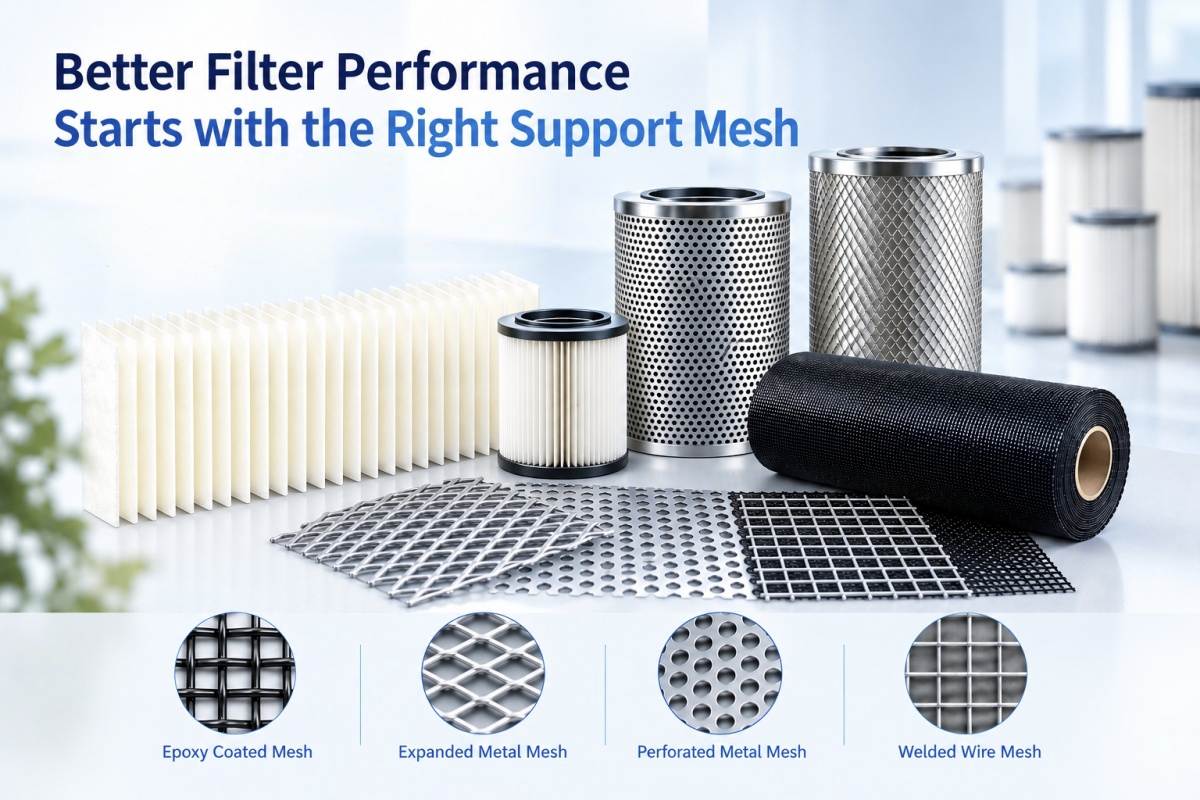
When designing a filter element, the filter media and support mesh should not be considered as completely separate components. The media determines the filtration function, while the filter support mesh helps maintain structural stability and protect the media during use and handling.
However, different filter media can have different levels of thickness, flexibility, strength and structural stability. These differences can affect how much support is required and what type of mesh structure is appropriate.
For filter manufacturers, the goal is therefore not simply to choose the strongest support mesh, but to select a mesh that is compatible with the media and the overall filter construction.
1. Consider the Structure and Stiffness of the Filter Media
Different filter media behave differently during handling and filter-element construction.
Some media are relatively flexible and require more structural support, while others have greater inherent stiffness and may require less reinforcement.
When selecting support mesh, manufacturers can consider:
· Media stiffness
· Media thickness
· Tensile strength
· Flexibility
· Required mechanical support
The support mesh should provide sufficient reinforcement without unnecessarily restricting the movement or forming of the media.
2. Match Mesh Opening with the Media
Mesh opening is another important consideration.
A support mesh with smaller openings can provide more continuous support for the filter media. A larger opening, on the other hand, provides a greater open area for air or fluid to pass through.
The appropriate opening therefore depends on the balance between:
Media support ↔ Open area ↔ Flow requirements
3. Consider Wire Diameter and Mesh Rigidity
Mesh opening alone does not determine the support capability of a mesh.
Wire diameter also affects:
· mechanical strength
· stiffness
· mesh weight
· flexibility
· available open area
For example, two meshes may have similar opening sizes but different wire diameters and therefore behave differently during filter-element manufacturing and service.
This is why support mesh selection should consider the complete mesh structure, rather than mesh opening alone.
4. Match the Mesh to the Filter Element Construction
Support requirements can also vary according to the filter element construction.
Pleated Filter Elements
For pleated elements, the mesh may need to provide support while remaining compatible with the media and forming process.
Cartridge Filters
For cartridge-style elements, support mesh can help reinforce the media and maintain its shape during operation.
Panel Filters
For panel filters, mesh may serve as an internal support layer or an external protective structure, depending on the filter design.
5. Consider the Filtration Application
Application | Support Mesh Considerations |
Air filtration | Open area, flexibility, media support |
Hydraulic filtration | Mechanical strength, dimensional stability, fluid compatibility |
Oil filtration | Support, corrosion resistance, media compatibility |
Dust filtration | Structural support, protection, dimensional stability |
6. Choose the Material According to the Working Environment
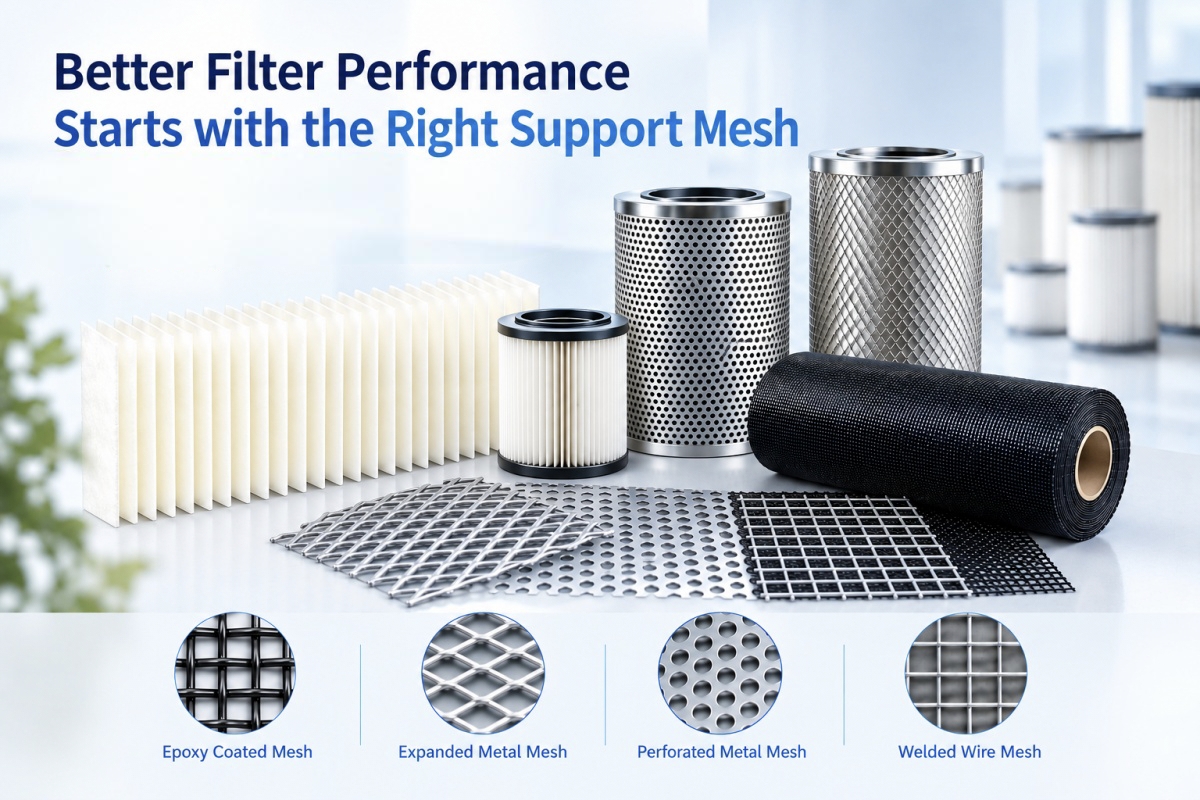
Epoxy Coated Mesh
Suitable where a coated steel support structure is required, particularly when corrosion resistance and surface protection are important considerations.
Expanded Metal Mesh
Provides a relatively rigid support structure and can be used where dimensional stability and mechanical reinforcement are important.
Perforated Metal Mesh
Offers controlled perforation patterns and can be selected where a rigid sheet-like support structure is required.
Welded Wire Mesh
Provides a welded support structure and can be used for media reinforcement or protective applications.
7. A Practical Selection Approach
Step 1 — Understand the filter media
What is its thickness, stiffness and structure?
Step 2 — Define the support requirement
How much mechanical reinforcement does the media need?
Step 3 — Consider flow requirements
How much open area is required?
Step 4 — Consider the filter construction
Is the mesh used internally, externally, or together with the media?
Step 5 — Consider the operating environment
Air, oil, hydraulic fluid, dust or other conditions?
Step 6 — Select the mesh structure
Consider:
Material + opening + wire diameter + thickness + rigidity + surface condition
For filter manufacturers, choosing support mesh is not simply a matter of selecting the strongest or most open mesh. The mesh should work together with the filter media and the overall element construction.
At HUZE, filter support mesh can be supplied in different structures, materials, openings, wire diameters and dimensions according to customer requirements. This allows manufacturers to evaluate the mesh based on their specific filter design and application.
The right support mesh is the one that provides the required reinforcement while remaining compatible with the media, flow requirements and manufacturing process.
Welcome contact HUZE for any of your inquiries or questions sales@huzemesh.com
Tags: #FilterSupportMesh #FilterMedia #FilterElement #FiltrationSolutions #MeshSelection