

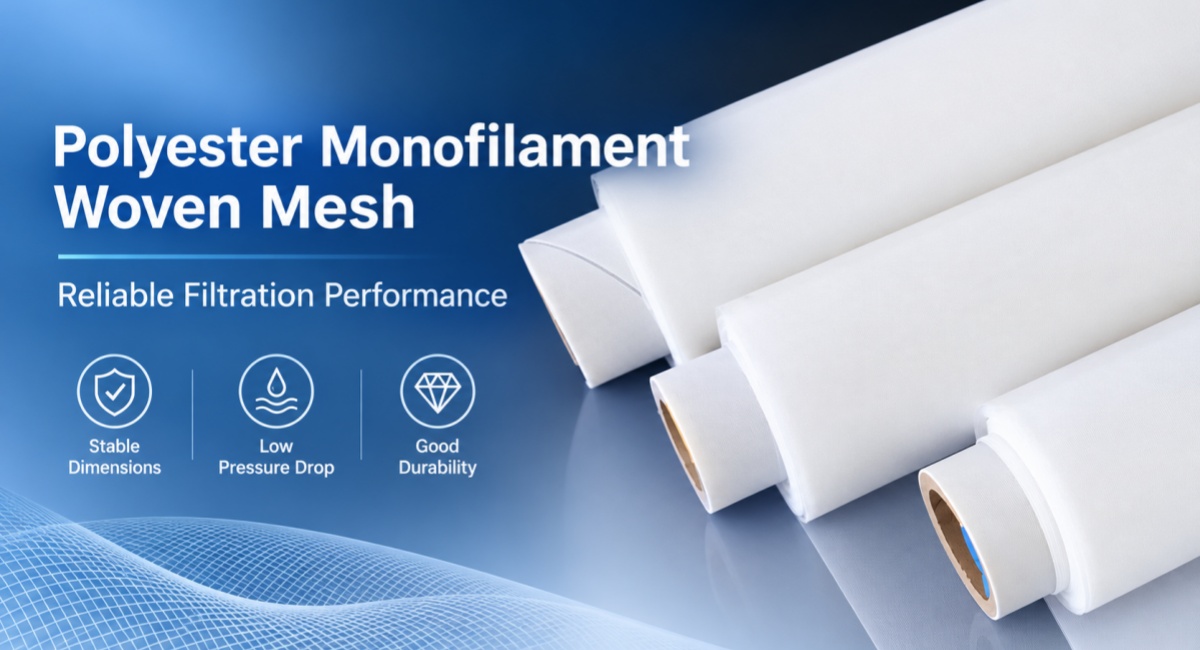
Polyester monofilament woven mesh (PET monofilament filter mesh) is a widely adopted surface filtration material, manufactured by precision weaving of solid polyester monofilaments. Thanks to its stable pore structure, clean performance and reusability, it is commonly used in liquid filtration, air pre-filtration, particle grading, filter support, food and beverage processing, paint and ink filtration, and other industrial separation applications.
Below are its key filtration characteristics:
Consistent pore size and predictable particle retention
Produced from uniform round single filaments and finished with heat setting, this woven mesh delivers highly consistent opening sizes and stable, controllable filtration ratings. It performs reliably for precise particle grading and fixed micron filtration requirements.
Excellent dimensional stability with low moisture absorption
PET monofilament features a very low moisture regain rate (less than 0.4%). It maintains stable dimensions when exposed to water or humid working conditions, with minimal change in pore size during repeated wet cycles. This supports consistent, repeatable filtration performance over long service runs.
Smooth filament surface, easy cleaning and reusability
The smooth round surface of polyester monofilament helps filter cake release readily. The mesh can be cleaned effectively via backwashing, high-pressure water rinsing or ultrasonic cleaning for repeated use. It has low risk of fibre shedding, which makes it well-suited for applications where filtrate cleanliness is important, such as food, pharmaceutical, cosmetic and coating filtration.
High open area, low pressure drop and high flow capacity
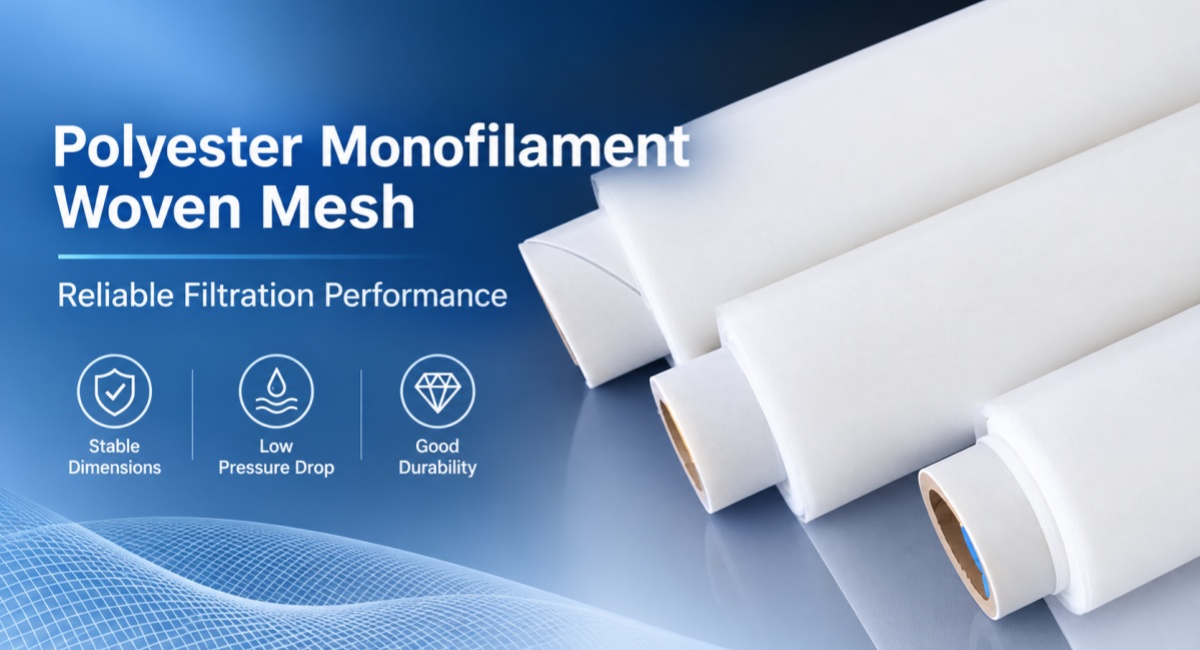
With straight through pore channels, polyester monofilament woven mesh offers a high open area. At equivalent filtration ratings, it supports high throughput and favourable pressure loss performance, suitable for both liquid and gas filtration, and helps optimise energy consumption for pumping systems.
Good mechanical strength and abrasion resistance
After thermal stabilization, the mesh achieves good tensile strength and low elongation. It holds its shape well when tensioned and framed, and offers good resistance to abrasion from solid particles. It is frequently selected for vibrating sieve screens, filter discs, filter bag support mesh and filter cartridge backing nets. Its continuous operating temperature typically ranges from 110℃ to 150℃, depending on heat treatment specifications.
Balanced chemical compatibility
It demonstrates good resistance to dilute acids, oils, hydrocarbons and many common oxidizing agents, performing steadily in a wide range of general industrial chemical environments. Important note: Polyester mesh is not recommended for strong alkaline service. Hot, concentrated caustic solutions may cause hydrolysis of the PET material.
Broad specification availability
Multiple weave styles are available, including plain weave, twill weave and Dutch weave. Micron ratings cover coarse screening down to fine filtration around 5 micron. It can be supplied in rolls, cut sheets or fabricated filter components to match different filtration equipment.
Practical considerations for selection
· It is naturally hydrophobic, so initial wetting with pure water may take time; hydrophilic modification can be provided upon request.
· It functions as a surface sieve media, primarily retaining particles larger than its opening size. For submicron particle capture, it can be combined with other suitable filter media.
· Long-term exposure to strong ultraviolet radiation may accelerate ageing. UV protection is recommended for outdoor installations.
· Excessive working pressure may lead to mesh stretching and pore size variation, so appropriate working pressure and tension control are recommended.
Reference comparison with other common filter media
Different filter materials are designed for different application priorities, and each has its own advantages for matching working conditions.
· Polyester monofilament mesh VS Nylon monofilament mesh:
Polyester monofilament mesh stands out for low moisture absorption and stable dimensions under wet conditions, together with good dilute acid resistance. Nylon monofilament mesh offers attractive elasticity, natural hydrophilicity and good alkali resistance for suitable scenarios.
· Polyester monofilament mesh VS Multifilament filter cloth:
Polyester monofilament mesh features smooth filament surfaces, easy cake release and good reusability. Multifilament filter cloth provides depth filtration effects and is widely chosen for applications where deep particle holding capacity is required.
· Polyester monofilament mesh VS Stainless steel woven mesh:
Polyester monofilament mesh is lightweight, cost competitive and metal-free. Stainless steel woven mesh excels in high-temperature resistance and robust resistance to harsh corrosive environments for high-demand industrial conditions.
Polyester monofilament woven mesh is a reliable, cost-effective option for industrial separation. If you are sourcing filter support mesh, liquid filter screens or sieve mesh requiring stable micron rating and clean reusability, it is one of the preferred solutions to consider.
HUZE Team
sales@huzemesh.com